What role does stencil printing play in pcb production and assembly?
stencil printing play in pcb production and assembly
Stencil printing plays a crucial role in PCB (Printed Circuit Board) production and assembly, serving as a key process in applying solder paste to the PCB before components are placed. This step is vital for ensuring that electronic components are securely attached to the board and that electrical connections are made correctly. The precision and efficiency of stencil printing directly impact the overall quality, reliability, and performance of the final PCB. Understanding the stencil printing process and its significance helps elucidate why it is a cornerstone in modern PCB manufacturing.
The stencil printing process begins with the creation of a stencil, which is typically made from a thin sheet of stainless steel or a similarly durable material. The stencil is laser-cut to create openings that correspond to the pads on the pcb production and assembly where solder paste needs to be applied. The accuracy of these openings is critical, as they determine the precise amount and location of solder paste deposited onto the PCB. Any deviation can lead to defects such as solder bridges, insufficient solder, or misaligned components.
During the stencil printing process, the PCB is placed in a fixture to hold it steady. The stencil is then aligned over the PCB so that the openings in the stencil match the pads on the board. A squeegee blade is used to spread solder paste across the surface of the stencil, forcing the paste through the openings and onto the PCB pads below. This action needs to be smooth and consistent to ensure an even application of solder paste. The type and quality of solder paste used are also important, as it must have the right viscosity and particle size to flow through the stencil openings without clogging.
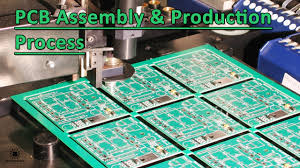
What role does stencil printing play in pcb production and assembly?
One of the primary advantages of stencil printing is its ability to apply solder paste accurately and efficiently across large numbers of PCBs in a production run. This precision is essential for modern electronic devices, which often contain hundreds or even thousands of tiny components that must be placed accurately. Stencil printing allows for high throughput and repeatability, making it suitable for both small and large-scale PCB manufacturing.
After stencil printing, the PCBs move on to the pick-and-place machines, where electronic components are positioned onto the board. The solder paste applied during stencil printing holds these components in place temporarily. Once all components are placed, the PCB undergoes reflow soldering, where it is heated to melt the solder paste, creating strong, permanent electrical connections between the components and the PCB pads. The quality of the solder joints formed during reflow soldering is directly influenced by the precision of the stencil printing process.
Another critical aspect of stencil printing is its impact on rework and repair. Accurate solder paste application reduces the likelihood of defects that require rework, such as tombstoning, where a component stands on end rather than lying flat. By minimizing such defects, stencil printing enhances overall production efficiency and reduces costs associated with repairs and rework.
The ongoing advancements in stencil printing technology also contribute to the growing complexity and miniaturization of PCBs. For instance, the development of finer pitch stencils enables the production of PCBs with very small and densely packed components, meeting the demands of modern electronics that require compact and high-performance designs. Innovations in stencil materials and laser cutting techniques continue to improve the precision and durability of stencils, further enhancing the reliability of the stencil printing process.
In conclusion, stencil printing is a fundamental process in PCB production and assembly, crucial for applying solder paste with precision and efficiency. It ensures accurate component placement, reliable solder joints, and overall high-quality PCB manufacturing. As electronic devices become increasingly sophisticated and compact, the role of stencil printing in achieving the necessary precision and consistency in PCB production will continue to be of paramount importance. Understanding its significance helps appreciate the meticulous processes behind modern electronics manufacturing.















































Post Comment