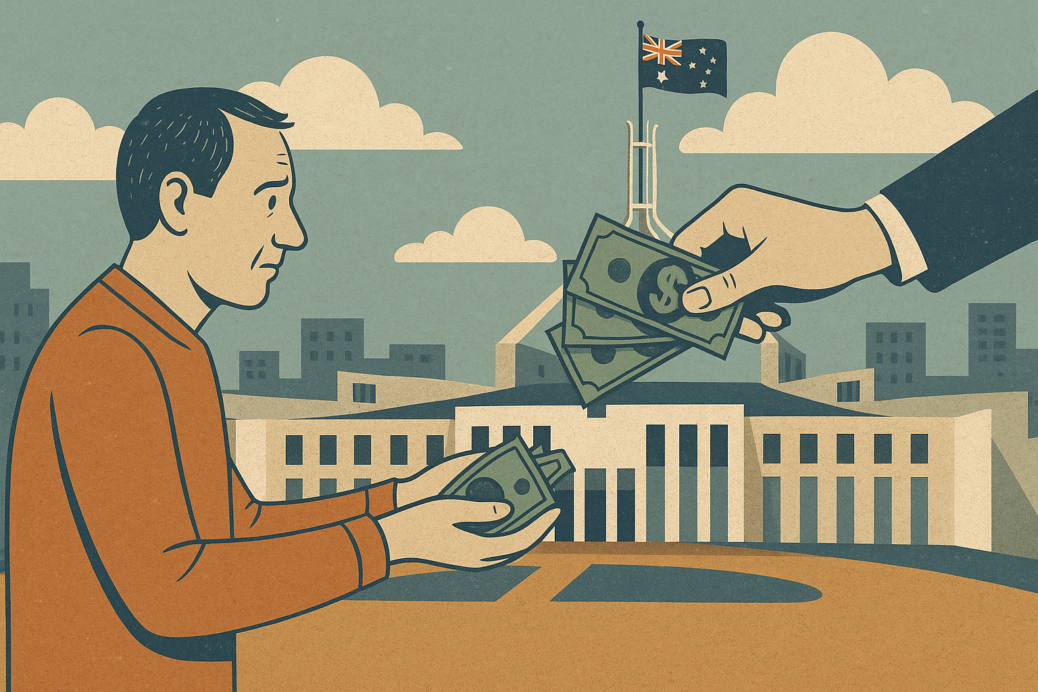
Are We Building a Nation of Dependants? Why Australia’s Growing Reliance on Government Income Should Concern Us All
Key takeaways
Over 50% of Australian voters now rely on government money as their primary source of income, whether via wages, welfare, subsidies, or aged/disability care.
This is a massive cultural shift, not just a fiscal one; we’re normalising dependency, not empowering independence.
According to the Centre for Independent Studies, this dependency is underpinning the largest peacetime government spending surge since WWII.
As more voters become reliant on government money, political pressure builds to keep spending high.
Cuts or reforms become politically toxic, meaning governments are incentivised to expand, not shrink, programs.
We’re entering a “feedback loop” of dependency, which makes meaningful reform increasingly difficult.
There’s a quiet but powerful shift happening in the Australian economy, and it’s not getting the attention it deserves.
More than half of Australian voters now rely on government support for their primary income.
Whether it’s through public sector wages, welfare payments, disability support, childcare subsidies, or aged care funding, over 50% of voters are dependent on government largesse to get by.
That’s not just a statistic, it’s a warning light blinking on our economic dashboard.
According to a recent report by the Centre for Independent Studies reported by the Australian Financial Review , this growing reliance is fuelling the biggest public spending spree we’ve seen since World War II.
And it’s not just about cost.
In my mind, it’s about culture because we’re not just spending more, we’re building a system where dependency is becoming institutionalised.
Government spending is at a post-war high, and it’s not about to slow down
According to the article in the AFR, Federal and state government spending has surged to 39% of GDP: well above the 34–35% range that held steady before the Global Financial Crisis.
And the major driver is social programs and the so-called “care economy.”
Let’s look at just one piece of the puzzle: the National Disability Insurance Scheme (NDIS).
Originally envisioned as a compassionate support net, the NDIS has ballooned beyond expectations.
At $52 billion, it now exceeds spending on the age pension, defence, and even Medicare.
Add to that:
-
$14 billion a year for childcare subsidies (more than double the 2018 figure)
-
$90+ billion in total disability-related payments (NDIS + support pensions + carer payments)
-
A push for universal childcare that could add another $13 billion annually
-
Hidden off-budget items, including green energy investments and reduced student debt, totalling $104 billion over five years
This kind of fiscal expansion is unprecedented in peacetime.
Dependency isn’t just financial, it’s cultural
The biggest issue here isn’t the dollars. As I said, it’s the mindset.
When more than half of voters depend on government spending to pay their bills, it creates a political environment hostile to restraint.
Politicians aren’t incentivised to cut spending or reform entitlements.
Why would they, when voters have come to expect more, not less?
As CIS senior fellow Robert Carling put it, we’re entering a “feedback loop”, a political and social system that rewards ever-growing entitlements.
Now don’t get me wrong, I believe support for those in genuine need is part of a civil society. It’s what we pay our taxes for.
But when support morphs into systemic reliance, we’ve crossed a line from empowerment to entitlement.
What does this mean for our economic future?
This culture of dependence has real economic consequences:
1. Rising public debt
As borrowing costs climb (no thanks to interest rates reverting to long-term norms), our ballooning debt will become harder to service.
Interest payments alone are expected to rise by almost 10% a year for the next decade.
That’s money that won’t be spent on productive investments.
2. Weaker productivity growth
Four out of every five new jobs created in the past two years were in the non-market sector: health, education, and public admin.
These roles are often necessary, but they don’t typically drive productivity gains.
More bureaucracy, less innovation.
3. Higher taxes on the horizon
With spending outpacing revenue, the inevitable question is: who pays?
The answer, as always, is the taxpayer. And that’s probably you and me
Whether it’s bracket creep, higher GST, or new taxes on investment, those creating wealth will be asked to carry a growing burden.
Why this matters for property investors and wealth builders
Now, you might be wondering, what does all this have to do with property?
Everything.
When a growing share of the population is reliant on government support, economic resilience weakens.
The government’s capacity to invest in infrastructure, housing supply, or tax reform gets squeezed.
At the same time, wealth creators, investors, business owners, skilled professionals, face higher taxes and tighter regulations.
The Albanese government’s ambitions include universal childcare, free TAFE, expanded Medicare, sound attractive on paper.
But they come at a cost.
And if those costs aren’t matched with reforms that lift productivity or unleash private sector growth, the result is slower economic momentum and more pressure on future taxpayers.
For property investors, this shift implies:
-
A more constrained fiscal future, which could reduce government capacity to stimulate housing.
-
More interventionist policies (think rent caps, land tax hikes, and regulatory creep) as governments try to “fix” affordability via levers that often backfire.
-
Increased reliance on immigration to prop up growth and demand, supporting long-term property fundamentals, but possibly straining infrastructure and housing supply.
The bottom line: growth must come from productivity, not subsidies
As I see it, Australia faces a choice.
We can continue down the path of dependency, expanding government programs, inflating the public sector, and deferring tough decisions.
Or we can return to a model that rewards productivity, encourages self-reliance, and fosters economic resilience.
Jim Chalmers’ upcoming economic reform summit is a timely opportunity to ask some hard questions.
But let’s hope it leads to more than a reshuffling of subsidies and a few tweaks to the tax system.
Real reform means reshaping incentives, trimming bloated programs, and focusing government spending where it truly adds long-term value.
Because in the end, prosperity doesn’t come from what the government gives you, it comes from what you create, build, and invest in yourself.













































Post Comment